
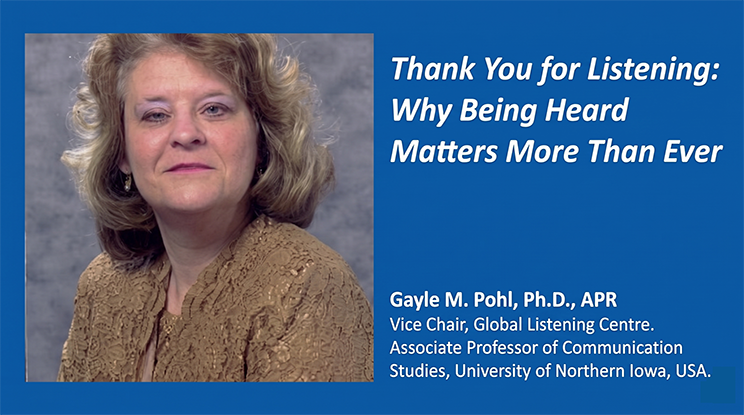
Thank You for Listening: Why Being Heard Matters More Than Ever
Gayle M. Pohl, Ph.D., APR
Vice Chair, Global Listening Centre.
Associate Professor of Communication Studies,
University of Northern Iowa, USA.
Introduction: A Campaign Built on Gratitude
The simplest words can sometimes carry the greatest meaning. “Thank you for listening” may appear to be an ordinary expression of appreciation, yet behind those words lies one of humanity’s deepest needs: the need to be heard.
At a time when communication technologies allow people to speak across continents in seconds, many individuals continue to experience loneliness, misunderstanding, and disconnection. We live in an era saturated with messages but often deprived of meaningful attention. The paradox is striking. Never before have people had so many opportunities to express themselves, yet never before have so many reported feeling unheard.
The Global Listening Centre’s “Thank You for Listening” campaign was created in response to this challenge. The campaign recognizes a simple but transformative truth: listening changes lives. It encourages people to acknowledge those individuals whose willingness to listen provided comfort during grief, encouragement during uncertainty, guidance during difficult decisions, or simply the reassurance that someone cared enough to understand.
Listening is often invisible. The campaign seeks to make it visible.
The Forgotten Side of Communication
Communication scholars have long noted that public attention tends to focus on speaking rather than listening. Contemporary culture celebrates visibility, influence, persuasion, and self-expression. Organizations invest substantial resources in communication strategies, branding initiatives, and public messaging. Social media platforms reward those who attract attention and build audiences.
Yet communication is not merely the transmission of information. Communication achieves its highest purpose when understanding occurs.
Listening scholar Gemma Corradi Fiumara (1990) described listening as the neglected side of language, while Macnamara (2016) argued that modern organizations frequently excel at speaking but struggle to listen effectively. These observations point toward a larger social problem. The challenge facing contemporary society is not a lack of communication but a lack of meaningful listening.
The Global Listening Centre has spent years advancing awareness of this distinction. Through research, education, advocacy, and recognition programs, the Centre emphasizes that listening is not passive behavior. It is an active, intentional practice that shapes relationships, organizations, communities, and societies.
Why Being Heard Matters
Most people can identify a moment when another person’s willingness to listen altered the course of their lives.
Perhaps it was a teacher who recognized hidden potential. Perhaps it was a mentor who offered understanding during uncertainty. Perhaps it was a healthcare professional who listened beyond symptoms to hear fears and concerns. Perhaps it was a friend who remained present during grief.
In many of these situations, the listener did not solve the problem. Instead, the listener provided something equally important: recognition.
The experience of being heard communicates a powerful message. It tells individuals that their experiences matter. Research consistently demonstrates that perceived listening contributes to trust, relational satisfaction, emotional well-being, and psychological safety (Bodie, 2011). Conversely, feeling ignored or dismissed often contributes to frustration, disengagement, and isolation.
The importance of listening becomes particularly evident during periods of vulnerability. People facing illness, loss, trauma, uncertainty, or major life transitions frequently seek more than information or advice. They seek understanding.
Carl Rogers (1951) observed that empathetic listening creates conditions in which people feel safe enough to explore difficult thoughts and emotions. The listener’s role is not necessarily to direct the conversation but to create a space where honest communication can occur.
Listening as an Expression of Human Dignity
Listening is more than a communication skill. It is an affirmation of human dignity.
Public discussions of dignity often focus on rights, justice, and equality. Yet dignity is also experienced through everyday interactions. It emerges when people feel respected, acknowledged, and taken seriously.
Attentive listening communicates precisely this form of recognition.
Philosopher Martin Buber (1958) argued that authentic human relationships require encountering others as persons rather than objects. His distinction between “I-Thou” and “I-It” relationships remains especially relevant in contemporary society, where stereotypes, labels, and assumptions often replace genuine understanding.
Listening creates the conditions necessary for authentic encounters. When individuals listen carefully, they affirm the humanity of another person. They acknowledge that another individual’s experiences, perspectives, and concerns deserve attention.
For this reason, listening often becomes especially meaningful in healthcare, education, community service, caregiving, and public life. Even when circumstances cannot immediately be changed, the experience of being heard changes how those circumstances are lived.
The Quiet Influence of Listeners
History often celebrates those who speak, lead, invent, or persuade. Yet many lives are transformed by individuals whose contributions receive little public recognition.
Teachers who listen to struggling students.
Healthcare professionals who hear concerns others overlook. Mentors who recognize possibilities hidden beneath self-doubt. Friends who remain present during grief. Family members who offer patience during uncertainty. Their influence rarely appears in headlines, yet it frequently shapes lives in profound ways.
This is precisely why the Global Listening Centre created the “Thank You for Listening” campaign. The campaign recognizes that listening itself is a form of leadership. It acknowledges the individuals whose attentiveness strengthens relationships, builds confidence, and fosters resilience.
By thanking listeners, society elevates a contribution that is often overlooked but deeply consequential.
Listening, Recognition, and the Global Listening Centre
Recognition begins with listening.
Before individuals can be celebrated for their contributions, their stories must first be heard. The Global Listening Centre has embraced this principle through its efforts to identify and recognize individuals—particularly women around the world—whose work has improved the lives of others.
The Centre’s recognition initiatives demonstrate that meaningful acknowledgment begins with attention. Listening allows important contributions to emerge from communities where they might otherwise remain unnoticed.
Through programs that honor women working in education, healthcare, public service, religion, science, the arts, humanitarian work, and community leadership, the Centre highlights individuals whose impact extends far beyond public visibility.
The underlying principle remains consistent: understanding precedes recognition. The Centre listens first. Then it celebrates.
Listening in an Age of Artificial Intelligence
As artificial intelligence increasingly influences communication, the value of listening becomes even more apparent.
AI systems can process language, identify patterns, summarize information, and generate responses with remarkable speed. These capabilities offer significant benefits across numerous sectors.
Yet listening involves dimensions of human experience that extend beyond information processing.
Empathy. Compassion. Emotional understanding. Ethical judgment. Shared vulnerability. Human presence. These qualities become particularly important during conversations involving grief, trauma, uncertainty, conflict, or major life decisions. In such moments, individuals often seek more than information. They seek connection.
Couldry and Hepp (2017) describe contemporary society as increasingly mediated through technological systems. While technology creates new opportunities for communication, it also raises questions about preserving meaningful human relationships.
Ironically, the rise of artificial intelligence may increase society’s appreciation for deeply human forms of listening. As machines become more capable of processing information, uniquely human capacities become more valuable.
Building a Culture of Listening
If listening contributes to trust, dignity, and social cohesion, then listening should be cultivated intentionally.
Educational institutions can teach listening alongside speaking and writing. Healthcare systems can evaluate whether patients feel heard. Organizations can recognize listening as a leadership competency. Governments and public institutions can create opportunities for meaningful engagement.
Macnamara (2024) argues that effective listening requires an “architecture of listening”—structures and processes that support genuine engagement. The same principle applies beyond organizations. Listening must become a cultural value rather than an occasional courtesy.
The Global Listening Centre’s Thank You for Listening campaign contributes directly to this effort by encouraging individuals to recognize listeners publicly and personally. Every expression of gratitude reinforces the idea that listening matters.
A Simple Thank You That Changes Lives
At its heart, the “Thank You for Listening” campaign is about gratitude. Listening requires time. It requires patience. It requires attention. It requires emotional presence. In an age characterized by distraction and constant demands, these qualities represent meaningful gifts.
When people thank those who have listened, they acknowledge the often-unseen work of understanding another human being. They affirm values that strengthen relationships and communities. They remind society that some of the most important contributions occur quietly, through presence rather than prominence.
The Global Listening Centre’s campaign reminds us that listening remains one of humanity’s most powerful acts. It strengthens trust, affirms dignity, nurtures resilience, and builds connection.
Most importantly, it reminds us that every person has the capacity to make a difference—not necessarily by speaking louder, but by listening more deeply.
Sometimes the most meaningful recognition begins with four simple words:
Thank You for Listening.
