
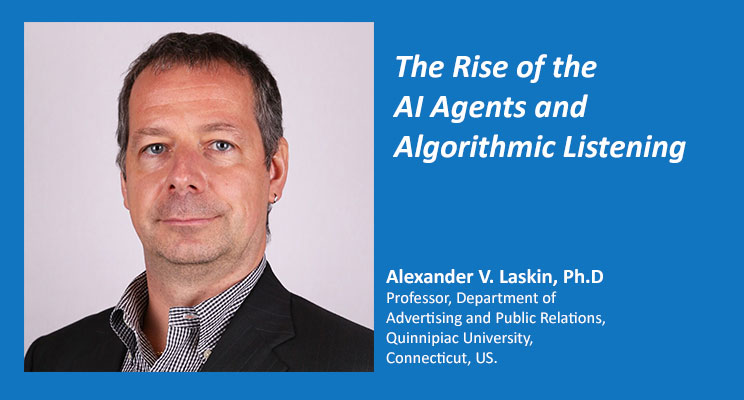
The Rise of the AI Agents and Algorithmic Listening
Alexander V. Laskin, Ph.D.
Professor, Department of
Advertising and Public Relations,
Quinnipiac University,
Connecticut, US.
Laskin’s (2025) analysis highlights the diminishing necessity of human labor and intellectual exertion. He proposes that this directs human identity toward consumption as the ultimate form of self-actualization—the transition from cogito ergo sum to I consume, therefore I am. This is the foundational context for the ascent of the AI agent. As life’s complexities—from managing personal finance and healthcare appointments to curating one’s vast media diet and anticipating shopping needs—outpace human capacity for optimal management, autonomous AI entities will step in to orchestrate a substantial portion of our daily existence. These agents will function as intelligent digital intermediaries, tasked with maximizing the comfort, convenience, and consumption satisfaction of their human principals.
In the context of marketing communications, it shifts marketing from consumers listening to corporate communications to AI agents listening to corporate messages. Algorithmic listening, then, is the imperative methodology for strategic communicators to successfully navigate this new terrain. It is the process of designing, disseminating, and continuously optimizing marketing, advertising, and public relations messaging not for human receptivity—which is often sporadic, emotional, and contextually inconsistent—but for the consistent, data-driven discernment of an autonomous AI agent. These agents, having access to real-time, comprehensive data on their users’ location, health, mood, and all historical consumption patterns, become the critical gatekeepers to the consumer’s attention and wallet. The marketing message is no longer heard by the person, but by the algorithm that is managing the person’s purchasing and content consumption decisions, a radical shift from human-to-human to algorithm-to-algorithm communication. The effectiveness of a communication campaign will be judged by its ability to persuade the agent of its alignment with the user’s articulated or inferred self-identity and ‘superfan’ devotion.
The wholesale shift to algorithmic listening and agent-mediated consumption presents both extraordinary opportunities for hyper-efficiency and disturbing prospects for social stratification.
The primary positive outcome is the realization of true, hyper-personalized communication at an unprecedented scale. With AI’s ability to create a potential “one million commercials personally customized for each of one million consumers” and to analyze vast data sets instantaneously, generic messaging will become a relic of the past. The AI agent, operating with a complete view of its user’s “superfan” identity—be they a ‘Swiftie’ or a devotee of a specific fictional universe or consumer brand—allows the communication to be perfectly integrated into the consumption experience. This eliminates the intrusive, interruption-based model of traditional advertising; the marketing becomes the entertainment, or more accurately, the content is seamlessly integrated with the product itself. For instance, an agent will not simply allow a pop-up ad for a drink; it will integrate a virtual rendering of the user’s favorite character drinking that exact product in their personalized stream of AR/VR content. For the strategic communicator, this allows for the nearly immediate attainment of their core goal: creating and maintaining relationships with “superfans” through a non-stop stream of relevant content. Moreover, the agent’s constant assessment of its user’s well-being via wearables provides an ethical dilemma that is often overridden by the promise of convenience and consumer satisfaction.
The most profound negative consequence of this reliance on AI agents is the exacerbation of existing socioeconomic divides, manifesting as the algorithmic wealth gap. The effectiveness of an AI agent is inextricably linked to its computational power, its access to proprietary, premium data streams, and the sophistication of its underlying models. The wealthy will be able to afford complex, costly premium agents—perhaps bespoke, continuously evolving entities—that execute their principals’ consumption and life management with optimal, highly effective outcomes. These premium agents will be better listeners, discerning more subtle shifts in mood, more efficiently filtering for socially and environmentally compliant brands (ESG/DEI alignment), and securing the most advantageous purchasing and content curation decisions. Conversely, the majority of the population will be relegated to non-premium, mass-market agents or even ‘free’ agents that are subtly monetized by their corporate creators. These agents, while seemingly beneficial, will operate on less sophisticated models and with less complete or even biased data sets, resulting in sub-optimal outcomes for their users.
They may be slower to adapt, less able to negotiate the most favorable terms for consumption, and more susceptible to the overt or subtle steering of marketing campaigns due to limitations in their ‘listening’ capabilities. Thus, the stratification of wealth—who can afford the best AI to mediate their consumption—will directly translate into a new form of digital and economic inequality. The premium AI agent becomes a competitive advantage, securing a more perfectly curated, satisfying, and economically prudent life for the affluent, while the basic agent may perpetuate a cycle of less efficient consumption for the less privileged. The very ability to receive effective communication will be commodified.
As Laskin (2025) writes in his chapter, by 2050, the communications industry will have fully adapted to this environment, recognizing that the human emotional core is now best accessed via its algorithmic proxy. The job of marketing, advertising, and public relations is no longer to interrupt the consumer, but to become an indistinguishable, integrated part of their digitally mediated life, steering their consumption to align with their self-defined identity.
The new mandate for the strategic communicator will involve an almost theological focus on Corporate Social Advocacy (CSA), as the AI agents of superfans will be rigorously programmed to listen for the brand’s signals indicating alignment with their user’s evolving political, ethical, and philosophical beliefs. This is because consumption is no longer merely a want, but a core component of the user’s self-identity, a public declaration of who they are and what they stand for. An agent’s listening criteria will prioritize a brand’s stance on global and micro-local issues above the functional quality of the product itself. Therefore, the creation and maintenance of a coherent, continuously communicated, and ethical CSA position becomes paramount to the success of algorithmic listening, determining whether a brand gains access to the privileged domain of the consumer’s agent or is permanently filtered out. The future of communication hinges not on speaking to the soul, but on crafting a message perfectly legible to the intelligent machine that guards it.
Yet, the fundamental ethical concern resides in the commodification of listening. In the agentic era, consumer agency—the capacity to make fully informed, self-directed choices that align with one’s genuine interests—is no longer an inherent right but a feature contingent upon a financial investment in a superior AI agent. The premium agent, accessible to the wealthy, operates as a sophisticated, ever-learning fiduciary, capable of:
- Perfect Filtering: It can meticulously scrutinize corporate social advocacy (CSA) communications to ensure a perfect alignment with its user’s complex ethical and political stances on ESG and DEI issues, effectively curating a consumption portfolio that fully validates the user’s self-identity as a “superfan.”
- Optimal Negotiation and Timing: Utilizing vast computational resources and proprietary data streams, it secures the most economically advantageous purchases and ensures communication delivery at the exact moment of peak susceptibility or need, maximizing convenience and minimizing wasteful consumption relative to the user’s goals.
In stark contrast, the standard or free agent, used by the less affluent, is likely to be a constrained and compromised listener. These agents may be:
- Data-Poor: Operating with restricted data access or reliance on less-sophisticated, potentially biased models, they fail to achieve the level of true hyper-personalization.
- Subtly Directable: The free nature of the agent may mask a contractual obligation for it to be more receptive to the marketing steering of its corporate creators, subtly guiding the user toward less efficient or more readily available products, even if they do not perfectly align with the user’s articulated identity.
References:
Laskin, A.V. (2025). Consumerism as the driving force of human identity in 2050: The role of marketing, advertising, and public relations. In A.V. Laskin & K. Freberg (Eds.), Public Relations and Strategic Communication in 2050: Trends Shaping the Future of the Profession. Routledge.
For more information, read: Laskin, A.V. & Freberg, K. (Eds.), Public Relations and Strategic Communication in 2050: Trends Shaping the Future of the Profession. Routledge.
