
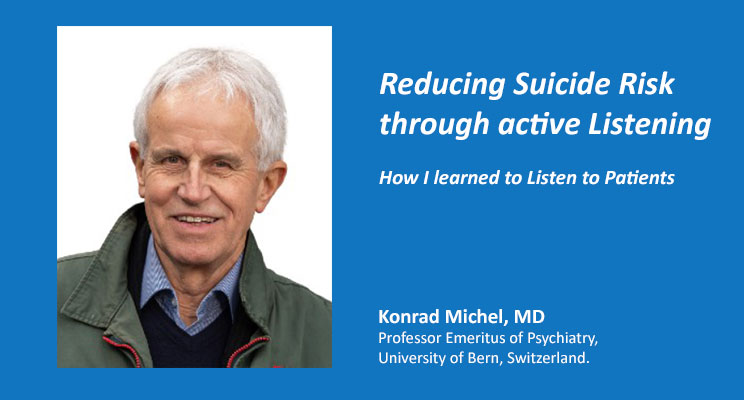
Reducing Suicide Risk through active Listening-How I learned to Listen to Patients
Konrad Michel, MD
Professor Emeritus of Psychiatry, University of Bern, Switzerland.
In my training as an M.D., I learnt that doctors ask questions about signs and symptoms, make a diagnosis and a prognostic assessment. When faced with patients referred after a suicide attempt, I realized that this approach did not help me to understand the personal meaning of their life-threatening actions. A psychologist colleague acted as an eye-opener by introducing me to the theory of goal-directed actions [1]: “Konrad, suicide is not an illness but an action! And we all explain and understand other people’s actions with stories”. I didn’t know at that time that this sentence would be the beginning of my metamorphosis, taking me away from my traditional role of the all-knowing doctor to a psychiatrist who was first of all a good listener. In first interviews with patients I learnt to stop myself from asking questions, and to trust the patients’ capacities to give me a coherent story of how they came to the point that they wanted to end their lives. I learnt that in order to understand a person’s suicidal development, only the patients could be the experts of their stories, while I was in the not-knowing position—a new experience for me! I learnt how incredibly important active listening – what in our clinical work we call narrative interviewing – is in order to create a therapeutic alliance right from the beginning in a patient-therapist relationship. It means that with the listening approach, patients become active participants in therapy, which is rewarding for the patients as well as for the therapists.
To my surprise most patients, when telling me their stories, spontaneously put their suicidal crisis into a biographical context. For example: “You know, I think it goes back to my childhood, when my parents separated, and I thought it was because of me”. That is, they were not merely talking about the actual emotional crisis, but they took me back to the early years of their childhood, telling me their stories of painful experiences, rejection, problems with self-esteem, self-blame, guilt, and many other unmet needs.
Once I had learned the basics of the listening approach, I soon discovered the enormous value of this kind of interviewing – in consultation with patients who came to see me because of health issues other than suicidality. Every first patient contact became a fascinating experience. Narratives clearly are the means for the therapist and the patient to find a joint understanding and allow change.
Here are the key issues for the listening approach to first patient contacts:
Invite the patient to tell the history related to the health problem that got them to seek medical consultation, with a standard sentence such as: “I would like you to tell me the story behind the problem that got you to come to see me, … to contact the crisis center, …to consider suicide as a solution, etc.” Do not interrupt with unnecessary questions, trust the patient’s narrative competence. Never ask “why.” The reason is that this would presume that there is a simple cause to a problem of mental health, which would exclude the personal story related to it. If necessary, help the patient to continue the narrative by using open ended questions, that is, questions that can’t be answered with yes or no. For instance: “Can you tell me more?”, “I am trying to understand” – “can you help me understand?”
Psychotherapy research in the 80’s and 90’s [2-4] concluded that the quality of the therapeutic relationship is a significant factor for therapy outcome, and, in particular, that the initial phase of therapy predicts therapy outcome. A health professional who is a nonjudgmental and attentive listener creates trust and becomes an ally of the patient, supporting the patient in coping with adverse experiences and suffering. This is why it is important to start a new patient contact with a narrative interview – not only with suicidal patients. I have adopted the listening approach to all my patients.
From our work with suicidal patients, we developed the Attempted Suicide Short Intervention Program (ASSIP), a brief, three-session therapy, in which the first session is completely dedicated to the narrative interview [5]. It is not surprising that ASSIP in an RCT has been shown to reduce the risk of suicide attempts by an amazing 80% over a two-year follow-up [6]. For me it is quite clear that the narrative approach and the quality of the therapeutic relationship make ASSIP an outstanding therapy program [7].
The training experiences, however, have revealed that even for experienced therapists it is not easy to become good listeners. Therapists with a medical training usually are the ones that find it most challenging to believe in the patients’ narrative competence, to listen without starting to ask questions. My principle in training therapists is: “If you ask questions you only get answers”. This insight goes back to my own training years. I learnt to use the Present State Examination, an extensive research questionnaire with 140 questions, developed to provide in-depth information on a patient’s signs and symptoms. In the group training, one of my colleagues interviewed a seventy-one-year-old female patient. He had gone through all 140 questions with her, without finding much pathology. The last question was: “Has there been something else recently that we have missed?” The patient answered: “Yes. I think you should know that I am pregnant and that I shall give birth to Jesus Christ.”
To end on a positive note, I am pleased to see that in the recent years an increasing number of clinical studies have reported an association between a narrative interviewing style and a reduction of suicidal behavior [8, 9].
If you are interested to learn more about how I learnt to listen to suicidal patients and what it means for treatment, read my book: Konrad Michel “The Suicidal Person – a new Look at a Human Phenomenon”, Columbia University Press 2023
https://cup.columbia.edu/book/the-suicidal-person/9780231205306
Konrad Michel, M.D., is professor emeritus of psychiatry at the University of Bern, Switzerland. Together with Ladislav Valach, Ph.D., Konrad Michel developed a model of understanding suicidal behavior based on the theory of goal-directed action and narrative interviewing. Konrad Michel is training, supervising, and supporting teams in Europe and overseas.
https://konradmichel.com/
References
- Michel, K., P. Dey, and L. Valach, Suicide as goal-directed action, in Understanding Suicidal Behaviour: the Suicidal Process Approach to Research and Treatment, K.v. Heeringen, Editor. 2001, Wiley & Sons: Chichester.
- Alexander, L.B. and L. Luborsky, The Penn Helping Alliance Scales, in The Psychotherapeutic Process: A Research Handbook, L.S. Greenberg and W.M. Pinsoff, Editors. 1986, Guilford Press: New York. p. 325-366.
- Crits-Christoph, P., et al., The dependability of alliance assessments: the alliance-outcome correlation is larger than you might think. J Consult Clin Psychol, 2011. 79(3): p. 267-78.
- Horvath, A.O. and L. Luborsky, The role of the therapeutic alliance in psychotherapy. Journal of consulting and clinical psychology, 1993. 61(4): p. 561.
- Michel, K. and A. Gysin-Maillart, ASSIP – Attempted Suicide Short Intervention Program. A manual for clinicians. 2015, Göttingen: Hogrefe Publishing.
- Gysin-Maillart, A., et al., A Novel Brief Therapy for Patients Who Attempt Suicide: A 24-months Follow-Up Randomized Controlled Study of the Attempted Suicide Short Intervention Program (ASSIP). PLoS Med, 2016. 13(3): p. e1001968.
- Michel, K. and D.A. Jobes, Building a Therapeutic Alliance With the Suicidal Patient. 2011, Washington D.C.: American Psychological Association APA Books.
- Lohani, M., et al., Collaboration matters: A randomized controlled trial of patient-clinician collaboration in suicide risk assessment and intervention. J Affect Disord, 2024. 360: p. 387-393.
- Huggett, C., et al., The relationship between the therapeutic alliance in psychotherapy and suicidal experiences: A systematic review. Clin Psychol Psychother, 2022. 29(4): p. 1203-1235.
