
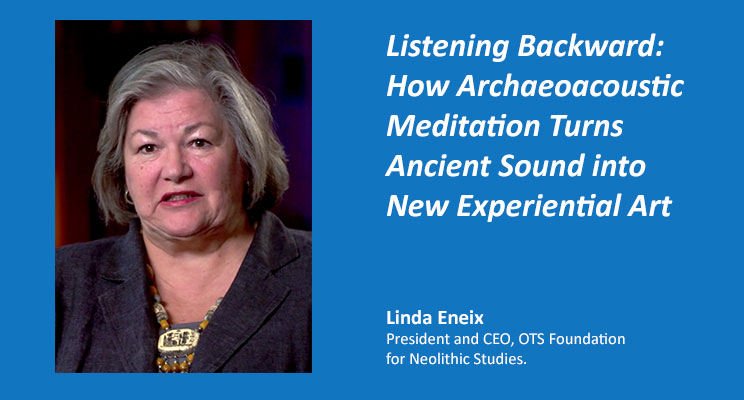
Listening Backward: How Archaeoacoustic Meditation Turns Ancient Sound into New Experiential Art
Linda Eneix
President and CEO, OTS Foundation
for Neolithic Studies.
In an age of infinite playlists and algorithmic calm, the modern soundscape is overflowing with noise, and it does not allow us any sense of peace. “Meditation music” has become a commodity – synthetic, looped, and stripped of context. It may relax the nervous system, but it rarely nourishes the imagination. The sound of a flute sampled a thousand times is not the same as the breath that first played it, nor the environment in which it might resonate with magical consciousness.
Long before apps and speakers, sound itself was sacred. For our ancestors, it was a way of knowing the world. Caves, stone chambers, and temple passages were not merely shelters; they were instruments. The hum of a human voice inside stone was a form of communication with the unseen. These were spaces designed for resonance—for communion, not consumption and certainly not for commercialization.
My research has been devoted to archaeoacoustics: the archaeology of sound. And over the past several years, I’ve been developing what I call “archaeoacoustic meditation”—a fusion of the human experience of special sound in ancient ritual and ceremonial spaces, guided reflection, and experiential art. It invites participants to listen not merely to sound, but through it: into the memory it carries. Each meditation is built from authentic field recordings made within prehistoric temples and chambers that are the oldest man-made sites on earth—places like Göbekli Tepe (in ancient Upper Mesopotamia, today part of Turkey), Karahan Tepe (also in Turkey), the Hypogeum of Ħal Saflieni (in Malta), and Newgrange (in Ireland)—where stone and air still hold the acoustic fingerprints of rituals performed thousands of years ago.
These pieces that I have developed are not intended as relaxation tracks. Rather, they are dialogues between ancient space and the living listener. A quick visual suggestion, the voice, the script, and the soundscape become a bridge to the Neolithic consciousness that once moved in rhythm with wind, water, and heartbeat. Within those resonant frequencies, the body feels what the intellect cannot: that we are continuous with all who came before us. The ear becomes a portal to ancestry. (For many of us of European extraction, this ancestry is literal and genetic.)
In the Ħal Saflieni Hypogeum, for instance, a single human tone can bloom into overtones that seem to swirl around the listener’s body. This is not digital trickery—it is architecture, vibration, and presence. It is physics. Humming at 110 hertz can set the entire chamber vibrating, enveloping anyone inside in a field of resonance. Scientists and acoustic engineers have measured it, but to experience it is something else entirely. That vibration bypasses the intellect and moves straight to the nervous system—the same way an unborn child feels its mother’s heartbeat through amniotic fluid. It is not metaphor; it is memory.
To record within such spaces is to collaborate with the past itself. When those sounds are paired with a spoken narrative rooted in archaeological fact, history becomes sensory. Listeners don’t merely imagine the ancient world—they can inhabit its acoustic dimension.
In the modern world, we are living through an era of profound disconnection—from nature, from ritual, and from the simple act of listening. Archaeoacoustic meditation offers a way back, not through nostalgia, but through embodied experience. It reminds us that technology can serve reverence as easily as distraction, if guided by intention and respect for origins.
This approach also bridges disciplines that have too often been kept apart: art, archaeology, anthropology, and contemplative practice. And when a guided meditation unfolds over the authentic pulse of a temple chamber, participants are not escaping into fantasy; they are returning to continuity—with the Earth, with the body, with the deep lineage of sound itself.
Today, we are surrounded by audio that has generally been engineered to pacify us. But true listening—the kind our ancestors practiced—is not about escape, nor is it about being pacified. Rather, it is about presence; it is about magically resonating with Neolithic origin. The sound of a human voice in a sacred space reminds us that history is not silent; it vibrates. Every echo carries a story that is still unfolding in us.
Archaeoacoustic meditation is an act of remembering how to listen again—with the same openness we had before birth, when hearing first taught us what belonging felt like.
