
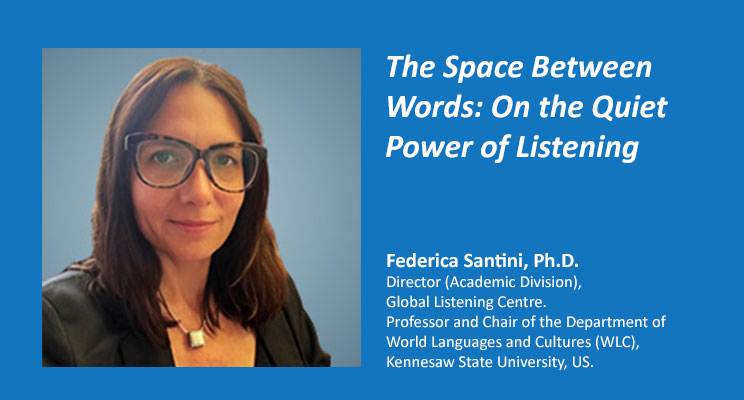
The Space Between Words: On the Quiet Power of Listening
Federica Santini, Ph.D.
Director (Academic Division),
Global Listening Centre.
Professor and Chair of the Department of
World Languages and Cultures (WLC),
Kennesaw State University, US.
As an administrative faculty member at a large public university in the United States, each year I review hundreds of student evaluations that contribute to the assessment of faculty in the department I oversee. These evaluations are simple documents, written hurriedly by undergraduate students as they wrap up each semester: some are generous with praise, often sweet or funny; others express frustration about unmet expectations or moments of misalignment in the classroom. Over time, however, a consistent pattern has emerged, especially for our strongest instructors within our large group of 70+, primarily international world languages and cultures faculty members. Again and again, students emphasize not just disciplinary expertise, knowledge of the materials, or organizational skills, but something far more fundamental: the professor’s ability to truly listen. Students describe the relief and motivation that come from being heard, from feeling seen as individuals rather than as names on a roster. Listening, it turns out, is not an accessory; it is central to the learning experience. What strikes me most is that students rarely use technical language to describe this. They do not speak of pedagogical strategies or instructional design, and very rarely do they address lecturing style. Rather, they identify meaningful moments: a professor who paused, who followed up, who remembered something the student had shared weeks earlier. These gestures, small on the surface, signal care and communicate that the student’s presence in the group matters.
This observation extends well beyond academic settings. In everyday life, how many conversations do we participate in where listening is only used as a tool for expressing our own viewpoint? How often are we merely waiting for our turn to speak, mentally rehearsing our response while the other person is still talking? In such moments, words are exchanged, but connection is thin, brittle. What if, instead, we shifted our attention to what is actually being said, beneath the surface, beneath our assumptions of the speaker and implicit biases? There is a truer form of communication available to us, a deeper way of being together, and it begins with listening.
In her book, Quiet: The Power of Introverts in a World That Can’t Stop Talking (Crown Publishers, 2012), Susan Cain challenges the cultural assumption that the most vocal individuals are also the most insightful. One of her most cited observations speaks directly to the value of listening: “There’s zero correlation between being the best talker and having the best ideas.” Cain reframes silence not as absence, but as space, a significant space where thought develops and understanding grows. While her focus is on temperament and personality, the implications for communication are profound. Insight and empathy often emerge not from constant assertion, but from careful attention to the life that surrounds us: raindrops on a quiet morning, the patter of children’s feet, the pauses and tones of our interlocutor’s discourse. Everything that goes beyond words and makes up a world that is fuller of meaning, if only we can stop long enough to take it in.
There is a space between words where anything can happen. Giuseppe Ungaretti, one of the central figures of twentieth-century Italian poetry, built an entire expressive language around brevity, silence, and the significance of the white space on the written page. Reflecting on the essence of poetry in his 1916 poem “Commiato” (Farewell), dedicated to his friend Ettore Serra and later collected in L’allegria, he wrote: “Quando trovo in questo mio silenzio una parola, scavata è nella mia vita come un abisso” (When I find a word in this silence of mine, it is carved into my life like an abyss). Ungaretti’s words remind us that meaning does not reside only in what is spoken, but in the silence that precedes and surrounds it. In poetry, the pause between lines is where resonance gathers, and that space challenges the reader to fully understand and, oftentimes, to participate in the creation of meaning—a known technique of experimental and “research” poets, who dare the reader to build significance out of their willed void. Listening works in much the same way. The space between words, when held with attention, becomes charged with possibility. It allows emotion, memory, and understanding to surface. Without that space, language flattens.
Silence creates possibility, interconnection, and understanding, but only through active listening can we learn how to perceive the value of that space and give it meaning. In this vein, Simone Weil wrote that “attention is the rarest and purest form of generosity” (this famous quote appears in a letter written by Weil to French poet Joë Bousquet dated April 13, 1942, which was later collected in the 1976 volume, Simone Weil: A Life). Listening, then, becomes an ethical act, a way of offering ourselves to another without interruption, to make ourselves truly available. This is where listening reveals its deepest power. Often, listening is treated as a passive act, something that happens automatically when we are not speaking. In reality, active, meaningful listening requires effort and intention. It asks us to slow down, to remain present, and to resist the urge to redirect the conversation toward ourselves.
Deep listening goes beyond hearing words and includes attending to tone, emotion, and what may be left unsaid. It requires curiosity rather than judgment, openness rather than immediacy. Yet, deep listening has become increasingly difficult in the interconnected world we inhabit. Technology provides endless opportunities to communicate, collaborate, and remain informed. Messages arrive constantly, notifications fragment our attention, tasks overlap without pause. While this connectivity offers undeniable benefits, it also encourages speed. Conversations are valued based on their perceived efficiency as we move quickly from one obligation to the next, often without processing what we have heard, or whether we truly listened at all. Ironically, the tools designed to connect us can create distance: when we listen while glancing at a screen, when we multitask during a conversation, we communicate, often unintentionally, that the moment does not deserve our full presence. Over time, this erodes trust. True listening requires something increasingly rare: quiet and slowness.
As I write this, I find myself reflecting on slowness and the deeper connections it makes possible. As a Tuscan woman, I grew up in a cultural rhythm that valued unhurried conversation. Meals stretched across hours, stories were told without interruption, retold for generations, with people from long ago coming to life again and again, long after their departure. Silence was never something dangerous, something to be filled with our own words. In those moments, around a table or during a walk at sundown, orange light slanting on tiled roofs, listening became a true shared experience. That ancient rhythm stands in contrast to the pace many of us now experience. And yet, it offers us a reminder that when we slow down, conversations deepen, and our understanding of others increases. When we allow pauses and hold judgement, people may share what matters most. Listening then becomes an invitation rather than a transaction, and when we resist transactional interactions, we make room for a presence that does not seek efficiency, but rather understanding.
As the year turns, this lesson feels especially relevant. Periods of transition often bring noise: deadlines, expectations, uncertainty. The instinct is to move faster, to do more. But human connection does not come from fastness; it comes from pacing ourselves, from aligning our attention with what is deep rather than merely urgent, from reading others’ pauses and grasping what remains untold. And when we do slow down and listen, deeply and without an agenda, we begin to see others more fully, encountering perspectives that were previously invisible to us. We may not agree with everything we hear, but understanding does not require agreement. It requires openness. There is no winning in conversation, only connecting. Listening, at its best, allows us to move closer, closer to our students, our colleagues, and one another.
