
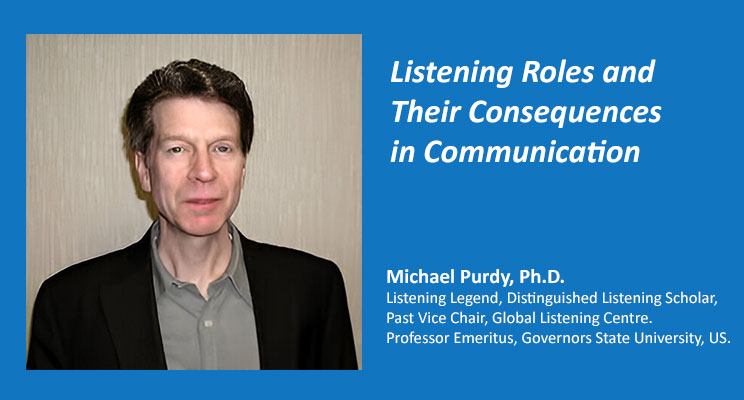
Listening Roles and Their Consequences in Communication
Michael Purdy, Ph.D.
Listening Legend, Distinguished Listening Scholar, Past Vice Chair, Global Listening Centre.
Professor Emeritus, Governors State University, US.
There is one aspect of listening that needs to be explored. This aspect of listening recognizes that there is nuance to the listening roles we enact and we must be aware of how we listen as we perform these roles. One role that will not be developed fully here, but needs to be explored is the difference in the conscious processing of listeners. For example, take aphantasia, an awareness where the listener has no visual imagination. Such a listener must be processing what they hear in a unique fashion. Listening roles and our conscious awareness depend a great deal on imagination; so what happens when at least one aspect of that listening is without imagination? The point here is to be open to the richly diverse roles we might enact, roles we don’t always choose, but which are important as we interact and listen.
Another role arises from the theory of psychological types developed by the Swiss psychiatrist Carl G. Jung (1875-1961) who wrote that what appears to be random behavior is actually the result of differences in the way people prefer to use their mental capacities. He observed that people generally engage in one of two mental functions:
- taking in information, which he called perceiving, or
- organizing information and coming to conclusions, which he called judging.
Within each of these, Jung saw people preferring to perform that function in one of two ways. These are called preferences. He also noted that, although everyone takes in information and makes decisions, some people prefer to do more taking in information (perceiving and listening) and others prefer to do more decision making (judging, based on the listening process). Finally, Jung observed, “Each person seems to be energized more by either the external world (extraversion) or the internal world (introversion).” What Jung called a person’s psychological type (playing a specific role) consists of his or her preference in each category.
There is one article that describes roles in terms of the listening attitudes, or tendencies of each of the 16 Myers-Briggs personality types—that is, how good each type is at listening. The 16 different styles, or roles, are very general and don’t give any details of listening per se, but rather give a brief description of how they perceive the process of listening rather than judging. Jung’s work seems a better place to work from as it is simpler and more useful, and not judgmental of the different personalities. There seems to be some literature that would indicate that there are different ways of processing/sensing/perceptual types/roles, and that at least in a broad way there may be different modes of listening consciousness. If that is generally true then we might need to give some general guidelines for recognizing the different modes of listening as different roles and learning how to adapt in different communication situations.
These are generally the communication roles and the contexts in which the conscious listener works artfully. We know that response is partly about the perception of the questions we ask in our listening role, but the questioning role is so very critical for the aware communicator that it must be considered critically. The structure of response in communication is integrally tied to listening effectively. Without thorough listening how can we know how to respond?
But all roles are activist listening roles; meaning to work with and for the speaker (and others in the conversation), and intervening to help the other as best one can. When one actively “stands back” and listens, taking the time required to let things “sink in” we are open to realize the potential of the situation. And it is important to let the whole event sink in; listening is an art and a challenge, and sometimes it is an obligation. If we are artful, our obligations to listen become a pleasant experience, even a role and experience we relish and look forward to. We listen to what is happening in the social or personal field and with that original awareness we realize the importance of treating every listening situation as a new quest, a fresh experience to relish and appreciate. Our presence tells us what is needed in the situation.
A contemporary example of a listening role and context of relevance is that of how companies handled getting employees who were working at home back to work: giving commands and attempting control did not work, according to Gleb Tsipursky, a behavioral scientist and consultant: “The key is not to have a command and control structure—that’s what so many bosses get wrong.” His research indicated most employees could be influenced to go back to work, but bosses needed to listen to what would be important to them if they were to return to the office instead of working from home.
In this paper listening roles are not fully elaborated, the object is more to focus on how each role requires different practices, especially with regards to the questions used or questing response, and acknowledging a certain responsibility of response. Without listening we cannot know how to respond; hence, we cannot be responsible. (There are other ways of describing the relation between listener and speaker(s). One is the Mandel Listening Practice—that organizes the conversational relationship in terms of a role that focuses on self, others, information, or the overall picture of ideas, concepts and possibilities. That is good but rather limited with regards to the richness and depth of the communication process.)
Following are six roles as typical of the many situations we inhabit as listeners.
- How about parenting as a critical role in the child’s developmental process.
- Or, the “Command and Control” position including the roles of leader, manager, commander.
Then there are the broad roles of problem solver including consultants.
Related is the salesperson or roles such as advertising/marketing, etc. The outcome sought here is one that benefits both the seller/marketer and the client. The ethic is one of finding the way to a common benefit that is transactional while also considerate of all parties, and that honors the people involved.
- Teaching/Learning—with the goal of learning to become more critical thinkers, and attaining information.
Including teachers, trainers, students, tutors, mentors, etc. The goal or outcome is to learn how to learn and hopefully act in different situations. The teacher/trainer should be open and listening and learning along with the student/trainee. The ethic is one of helping others to learn and grow while also respecting and listening to them and not judging.
- Supportive/therapeutic, including counselors, advisers, therapists.
- Creative/midwifery, including those who would help critical/creative thinking, problem solving, Socratic thought, drawing out, the poetic. Here the goal/outcome would seem to be the physical and mental health of the patient, but as Wilberg argues, the relationship of supporter/supported is one of growing together. To listen is ultimately to be fully open to any situation and to be receptive and changeable.
- And maybe there is a role that is not specific, the role of a listener without a specific objective?
For role five, midwifery, there is an overview and processes that operate in any situation, as well as an ethical framework and practice that makes sense. So overall, there are broad, general roles we assume as we listen. Just to be aware of these roles can be very helpful in understanding how we listen and respond in any communication situation. Being aware of these roles and their implications is an integral process of being a great listener.
References:
- Jung, C.G. (1971). ‘General Description of the Types’, in Psychological Types, Collected Works vol. 6, Ch. X, London: Routledge and Kegan Paul.
- Moodie, K. (Jul 13, 2017). How Good Each Personality Type is at Listening. https://personalitygrowth.com/how-good-each-personality-type-is-at-listening/
- For years in the late 20th century some argued that response was not part of the definition of listening.
- Goldberg, E. (April 16, 2023). “Meet the Office Whisperers” NY Times Magazine, p. 27-31.
- https://www.mandel.com/listening-skills-training-workshops
